STAR WARS: MACBETH

A restored edition from 1997 · website first published in 1998

Original purple and blue Star Wars Macbeth website banner

The Force is with Macbeth!

Star Wars: Macbeth is a seventeen-minute video production that follows the lives of three brave Scots in their quest for the throne of Scotland. George L. meets William S. in an odyssey that spans from the high-school cafeteria to the high-school gymnasium. Did I mention they had lightsabers?

Created for an English project in February 1997, Macbeth received rave reports from Glen Ridge High School. Its creators—that’s us!—decided it was worth putting up on the ’net. We enjoyed every aspect of production and hope that comes through in the final video.

This page is edited and condensed from the 1998 and 2000 sites. It keeps their section names, pictures, jokes, and first-person account while repairing spelling, accidental duplication, chronology, and obsolete playback. Names follow the public privacy policy: Don Fitz-Roy in full; everyone else by given name and last initial. Historical copy is labeled where its date matters.

Download Macbeth / modern access copy

STAR WARS: MACBETH is just a click away

The old page asked visitors to install QuickTime, Windows Media Player, or RealPlayer, then offered the movie in three formats and four pieces. These recovered files now play in ordinary browser controls. The period downloads remain linked as provenance.

Outtake reel · 3:56 · 320×240

Some funny clips and mess-ups

Posted on 4 September 2000 after “days of searching for tapes, analyzing footage, and editing.” The recovered MP4 in Documents and the preservation copy are bit-for-bit identical.

CNN Showbiz Today · 1:39 · recovered news report

The surviving television segment

The recovered report surveys the then-new world of online Star Wars fan films, shows TheForce.net, and includes the Star Wars: Macbeth site and green-saber footage among the examples. This local access copy replaces the incorrect television link used by the earlier restoration.

Behind the scenes

BEHIND THE SCENES ON STAR WARS: MACBETH

Whenever we read behind-the-scenes stories or interviews, we now know what they’re talking about because we’ve lived through it ourselves! Making a movie can be quite an experience. Here, we will attempt to bring this experience to you.

The Concept

Star Wars: Macbeth—who would have thought? Looking back, there were many similarities between William S.’s epic drama and George L.’s epic movie. Both use classical story types, dysfunctional families, headstrong heroes, and powerful villains. So why combine the two? Simple: we wanted to make a Star Wars video, and we were studying Macbeth in English class.

Bienvenido C. came rushing into chemistry after the bell to announce that we were making a movie called Star Wars: Macbeth. The rest was history. (...or should I say Chemistry?)

The Odyssey Begins

The core crew assembled within hours. Bienvenido C. and Don Fitz-Roy took the two leads. Michael M. wrote the script and played Young Siward, who became the Obi-Wan character. With about two weeks until winter vacation, we decided to film during the week off.

Yep... we would spend our high-school vacation INSIDE the high school.

The principal and custodians gave permission on the condition that we not break anything with the fake lightsabers. Michael M. wrote a short script: Macduff was good, Macbeth was evil; Macduff became Luke, Macbeth became Vader, and the dialogue became an amalgamation of William S., George L., and whatever helped the plot.

On Location

We carried three boxes of gear and props from Bienvenido C.’s house to the school, half dressed in costume. The inventory included a Darth Vader mask and black cape, a yellow “Luke Skywalker” jacket, a Sharp Viewcam, two white plastic rods, a bedsheet for Malcolm’s cape, and one rather dangerous halogen lamp. Two power converters from Tosche Station were also listed. (Just kidding.)

Pizza and the soda machine kept the crew fed. On the second-to-last day, Raymond P. proposed escaping in the Millennium Falcon. The gym was occupied by cheerleaders, but there were only two hours left before the school closed. We explained that we would be running through in Star Wars costumes and filmed anyway. The cheerleaders cannot be found in the finished shot: the composited Falcon hides them.

Post Production

Four or five shooting days produced enough footage, although at first we doubted it would form anything understandable. Editing changed that. The pacing began to work; the music helped immensely. Don Fitz-Roy fitted roughly fifteen John W. cues to the picture. It was crude editing, but music and image began to electrify each other.

The sabers and lasers took forever. Every frame had to be adjusted. Bienvenido C. made it happen and probably did not sleep much that week. A huge blue screen across his bedroom wall put the cast into the final awards ceremony.

The tape was finished

The cast and crew screened it the night before school resumed. We watched ourselves attempt to act and were bowled over with laughter—and pride, because we had begun something and seen it through to completion. The video was exciting, understandable, funny, and yes, even a little epic.

Star Wars: Macbeth wasn’t going to change the world, but it would be an experience we’d never forget.

As written in 1998

We held the tape in our hands...

And that’s why you’re reading this now. We wanted to share MACBETH with Star Wars fans and film fans. We wanted people to see how we spent the previous winter vacation—and, while the prequels were still in the future, to put some new Star Wars footage on the ’net. An old Jedi friend had the last word: DO OR DO NOT. THERE IS NO TRY. Get out there and do it.
Special effects

How we made these things work

When we set out to make Star Wars: Macbeth, it became apparent that actors and a storyline would not be enough. To hide the fact that we were NOT actors and had a rather loose storyline, the effects would have to carry the story.

Note: we could get away with this because we were in high school. When you’re making a $100 million movie, you need effects, acting, AND a story. Keep this in mind. :-)

Period sources disagree on one tool: the 1998 effects page names Adobe Premiere for the frame-by-frame saber work, while Don Fitz-Roy’s 1999 interview says the production stayed in Ulead MediaStudio rather than switching to Premiere. Both accounts are retained as evidence rather than silently reconciled.

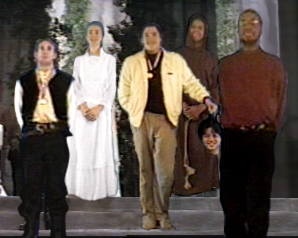
The completed awards-ceremony composite made with a blue screen
The gym floor replaced by the throne room in the completed composite.

Blue Screen

One of the first scenes put Macbeth and the Imperial Officer inside the castle—or the Death Star, depending on how you look at it. We hung a blue carpet from end to end of Bienvenido C.’s bedroom wall, filmed the actors in costume, and put the tape into the computer. MediaStudio selected the blue and removed it, making that part of the picture transparent. It was important that nobody wore blue, or they would have disappeared too.

The same method did the most work in the last scene. We watched the awards ceremony from A New Hope and wondered how crazy it would be to replace the whole scene. So we did. It was difficult, and Princess Leia’s hair did not always cooperate, but the cast walked down the aisle as if we had been in the original footage.

The finished lightsaber duel after frame-by-frame effects work
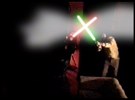
A finished rotoscoped frame from the final battle.

Rotoscoping and Animation

Lasers were animated red lines moving toward or away from the screen. The lightsaber battles used the same basic idea: during filming we fought with white plastic sticks; afterward, Adobe Premiere was used to alter every frame with red or green lines, layered to make a core and a translucent glow.

How many frames are there per second? 30. You do the math. It took a long time, but it made the fights look flashy—which was probably why somebody invented the whole saber idea in the first place.

A recovered frame showing a school interior transformed into the film setting
A recovered finished frame showing the transformed school interior.

Image Mattes

A matte removes a static part of an image and replaces it with something new. In our version, school windows became the emptiness of space. During Luke Skywalker’s Lament, the room behind Macduff holds a scene from The Empire Strikes Back while the soliloquy continues as if nothing unusual has happened.

The catch was that the camera could not move. If the frame moved, the matte would have to move with it. A locked camera was cheaper than another week at the computer.

Original purple Behind the Scenes graphic from the website
The original Behind the Scenes section graphic.

Traditional Effects

Sometimes the simplest explanation was the best one. A fishing rod and line held up Young Siward’s robe; letting out the line when Macbeth’s saber passed made the character disappear. Fishing line was also “The Force,” pulling Macduff’s saber into his hand.

More people asked about that simple trick than about the glowing lightsabers. Go figure.

The final battle filmed under colored stage lights
The final battle under the school stage’s red and blue lights.

Lighting

For most of the picture there was one rather dangerous halogen lamp. Carl Erik F. also doubled as lighting technician and flicked the hallway lights while the cast ran past, making the Death Star look as though it might be exploding.

The final battle was filmed on the high-school stage beside the cafeteria. The dark background, red and blue stage lights, and a full-strength industrial fan supplied the atmosphere. Between the wind and the heat, it felt like a storm up there. :-)

Original five-stage Millennium Falcon composite from the school gym
The original site’s five stages of the Millennium Falcon composite.

The Millennium Falcon Escape

The escape used nearly every trick we had. A toy Millennium Falcon was blue-screened over the three heroes running across the school gym. Inside the ship, blue screen put Han Siward, Macduff, and Malcolm into the places once occupied by Han, Luke, and Leia.

We replaced the viewing window with a handheld “fly-by” of the gym. Robert F.’s image was rotated to simulate hyperspace without a seatbelt. The theory behind these effects was simple; the hard part was choosing the right trick and making the illusion clean.

Read the preserved full effects page in context

Frequently asked questions

Questions people actually asked

Q: When was Macbeth created?

A: Macbeth wasn’t created. IT ALWAYS WAS. Seriously, the idea, filming, and editing occupied February 1997; the first school screenings followed in March. The website did not arrive until August 1998.

Q: Why was Macbeth created?

A: Yep. We lied on the opening page. The English assignment was only part of it. We were bored, had access to some cool video equipment, and wanted to show what we could do. The Star Wars Special Editions and Macbeth arrived at school at exactly the right moment.

Q: How did you make those sabers?

A: You thought those things were fake? No way! Actually: white plastic rods during filming, then colored cores and glow drawn onto every frame at the computer.

Q: What does the opening monologue read?

A: ACT V — Macduff Strikes Back. It is a period of Civil War. Rebel soldiers striking from Birnam Wood have stormed the castle. The mighty thane Macduff, obsessed with finding the tyrant Macbeth, has traveled thousands of miles to avenge his family’s murder, free the Scottish people from Macbeth’s villainy, and crown Malcolm as the rightful heir...

Q: What did the school think?

A: The school loved it. The principal kept a copy. The only worry was the sight of fake lightsabers being banged against the lockers.

Q: What equipment did you use?

A: A Sharp Viewcam, the school tripod, a roughly $100 capture card, a low-model Pentium, one halogen lamp, a rolling school cart that did not make a very quiet dolly, and a fishing rod. Two power converters from Tosche Station were listed as a joke.

Q: How was the premiere?

A: The AP Chemistry class made us play it again. Later it reached English class, at which point we knew we had the grade. Copies multiplied through the building, and classes briefly came to a standstill.

Q: Any goofs?

A: Macduff’s glasses wander during the soliloquy; a dropped saber returns between cuts; Young Siward jumps from swinging to ducking; Carl Erik F. shoots nearly everything except the spaceship; and Bienvenido C. used a stool in the opening scene to look taller.

Q: What’s with that Coca-Cola commercial?

A: It was the last day of shooting and the end-credits music outlasted the available footage. The soda machine had kept us going, so we filmed a thirty-second shrine to Coca-Cola and Star Wars. It became funnier when Pepsi turned out to be the official sponsor of the Star Wars films. :-)

Q: What is the meaning of life?

A: To get to Shell Beach.

Q: Why does Don fight like a wimp in the final battle?

A: My stick broke. No, really. It fell apart during the final take, so I ducked and scampered away. It worked out: Macduff was supposed to be losing until he used the Force. — Don Fitz-Roy, as written in the original FAQ

Who’s Who

The people behind the tape

The original Who’s Who page included student biographies and old email addresses. This restoration keeps the period credits but does not republish private contact details or guess at anyone’s current life.

Macbeth

Bienvenido C.

co-director · editor · visual effects · executive producer

Macduff

Don Fitz-Roy

co-director · music and sound edit · original website

Young Siward

Michael M.

screenplay · cast

Han Siward

Raymond P.

cast · ideas · costumes · props

Malcolm Calrissian

Robert F.

cast · ideas · costumes · props

Admiral Seyton / the Empire

Carl Erik F.

cast · lighting · the entire Imperial fleet

Princess Leia

Rebekah H.

cast · keeper of the Scottish crown

As written in 1998 · selected Who’s Who notes

Bienvenido C.

The 1998 page recalled that he had been acting and producing since childhood, made Mission: Impossible—Tom and Huck Rescue Jim during high school, and followed it with short videos, documentaries, and sports-highlight tapes.

Don Fitz-Roy

As the Luke Skywalker character, Don did his best to “whine and look stubborn.” The page listed directing, short stories, screenplays, soundtrack collecting, surfing the ’net, and referring to himself in the third person among his interests.

Michael M.

Besides playing Young Siward, Michael M. wrote the script from William S.’s final act, Star Wars dialogue, and original lines—“a compellation,” as the old page put it.

Raymond P.

The period biography called Raymond P. a video-editing enthusiast and noted short subjects and parodies including Ninja Spirit, a James Bond chase, and the Star Wars Cantina video.

The old page also contained student résumés, college notes, and personal email addresses. Those details are left in the untouched archive capture, not repeated here. Entries that were unfinished in 1998 have not been filled with invented biography.

Star Wars: Macbeth News

The website notices, 1998–2006

The first site goes online

The film had screened at school in March 1997. Seventeen months later, the first Glenridge site compressed the video for the ’net and gave the tape a public life.

The purple-and-blue rebuild

The site admitted that people could not download or play the video, links had died, and there was no News section. The rebuild added QuickTime, RealMedia, and Windows Media versions, along with the effects essay, publicity notes, and this report: “yes— Macbeth has been played on CNN.”

The outtake reel arrives

After searching for tapes and editing the mistakes together, the site posted the 3:56 reel now restored above. The same notice warned that some QuickTime audio had static and recorded continuing work on a CD edition.

The Force is back

Don Fitz-Roy relaunched the site at dcfr.net with remastered media. He described the content plainly: “pretty much the same,” with a few surprises. A valid capture of the later downloads page survives from 2020.

Header from the later DCFR Star Wars Macbeth site

CNN.com · 4 May 1999 · online article

“Star Wars sites clone rapidly on the Web”

The recovered article’s subhead reads: “Gossip, parodies, and the universe-according-to-L. share cyberspace.” It reports more than 1,200 Star Wars sites in Yahoo’s directory and describes TheForce.net, Troops, the official Star Wars site, Hollywood.com, and Ain’t It Cool News. It does not name Star Wars: Macbeth; it establishes the web culture in which this small school-made site circulated.

The separate Showbiz Today report above is the CNN artifact that actually shows the Macbeth site and footage. The original site’s 9 August 2000 News post records that broadcast while explaining why its old downloads had to be rebuilt.

Preservation notes

What survived, and what this edition changed

Primary text

The 1998 Glenridge pages supply the main prose and original section order. The 2000 edition supplies its purple-and-blue visual layer and News notices; Don Fitz-Roy’s 1999 interview supplements the production history; the 2006 DCFR page documents the relaunch. Parked-domain captures were not treated as source copy.

Media

The film is a browser access derivative encoded from a recovered local finished-film file. Trailer and outtakes are exact copies of the MP4 files in Don Fitz-Roy’s Documents folder. The CNN MP4 is a browser access derivative of the preserved WMV. No original was overwritten.

Privacy

Don Fitz-Roy appears in full. Other real people use a given name and last initial. Old personal email addresses, student-biography details, and identifying captions embedded in three unused images were not published here.

Where the sources disagree

The home page calls the film seventeen minutes; the download page calls it fifteen; the recovered film-only file runs 15:13. The FAQ remembers a Pentium while the 1999 interview remembers a 486. One account begins in chemistry, another in history. These differences remain visible instead of being forced into one tidy memory.